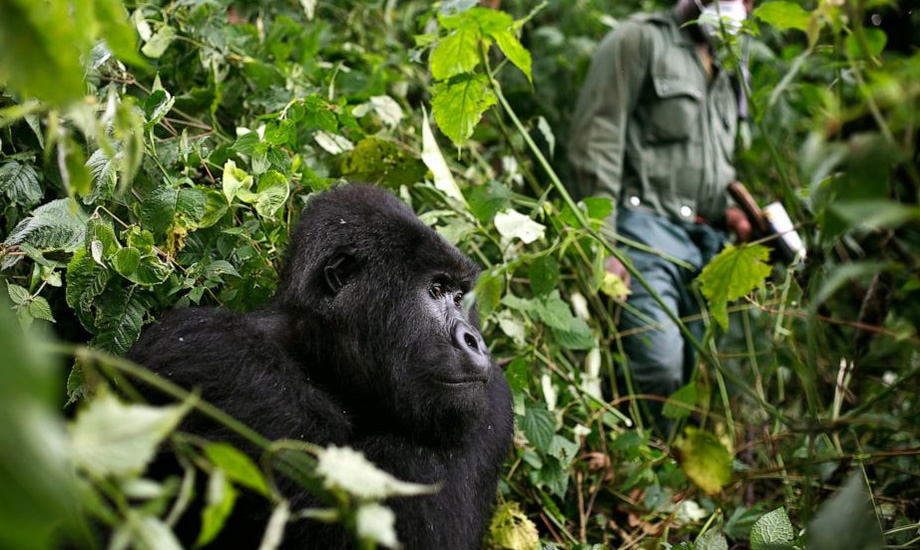
Mountain Gorillas Could be Extinct If Not Conserved

Of the few Mountain Gorilla’s that remain on Earth estimated less than a Thousand, almost half of the population live in Uganda’s Bwindi impenetrable National Park and Mgahinga National Parks while the rest can be found in the Volcanoes National Park in Rwanda and some in Democratic Republic of Congo (DRC). The Shy and Gentle Mountain Gorilla’s are the Earth’s largest living Primate and the Regions most famous tourism attraction. Bwindi Impenetrable National Park is said to host about 300 Mountain Gorilla’s, almost half the entire Mountain Gorilla population living in the wild today.

Several factors often threaten the existence of the Mountain Gorilla’s thus their dwindling population such as disease, poaching, human population encroachment of their habitat the rain forests among others. Gorillas are open to same diseases which effect humans since they are closely related to humans with similar anatomic and physiological features. Gorillas live in small groups any exposure to any kind of illness affects the entire group which may fail to recover from the entire fall that’s why human contacts are restricted. All Gorilla trackers are instructed to keep a distance from the Gorilla’s. Most scary diseases include flue, Scabies which can quickly spread from group to group as families interact.

Poaching is another threat which has claimed many lives of gorillas in the jungle forest till present for example a while ago some European and American scientists and trophy hunters killed over 50 mountain gorillas which effected the population of the living apes today. Hunting is another problem because many Gorillas have been injured by hunters who go to jungle to hunt other wildlife life. The latest events shows that hunting of mountain gorillas in order to capture their young ones by corrupt dealers remains a threat for example an infant gorilla was recovered outside Virunga national park in 2013 who was later the joined to other three rescued gorillas & orphan from poaching in Rumangabo for monitoring.

Population growth of the people living near the park is the worst of all threats since they both compete for the forest land. The people need land for farming, agriculture in order to support their families while Gorillas destroy the farm crops and also limit the local community from access the forest land. The only way to maintain gorilla habitat is to develop alternative economic activities that allow people to meet their daily needs, so that they see gorillas not as competitors, but as a means of improving their own situation.

The regional conflict is another threat, changing climate, weak regional collaboration but me & you can change this if we try. With a population of less than a thousand Mountain gorillas remaining in the world today, a lot of conservation effort is needed in order to conserve the mountain Gorillas for the Future Generation.

Dian Fossey, Carl Akeley, George Schaller are the other great gorilla conservationist who followed Robert & their work focused global attention on the troubles of gorillas. Still it’s that Effort which makes many travelers have wonderful lifetime memories every time they visit Uganda, Rwanda or DRC for Gorilla trekking adventures. We all agree that the above Conservationists did a great job in conserving the mountain gorillas without forgetting the local communities of Uganda especially around Bwindi forest and Mgahinga National park, Locals of Rwanda around and near the Volcanoes national park & the people of Democratic Republic of Congo (DRC). Each countries local community deserves a bonus for ensuring the survival of gorillas and also allowing the guests to access their reach jungle forest to trek the Gorillas. The National park staff like wardens and ranger guides has done a lot to ensure that the conservation rules can be maintained in all the three countries.

Several organizations have come up to conserve gorillas and these work hand in hand with both the local communities and park management. They include the mountain Gorilla conservation fund (MGCF), international Gorilla conservation program (with programs in Rwanda, Uganda and Congo), Fauna & Flora international (only in Rwanda), Wildlife Wild places & forests (WWF) all over Africa, Rwanda development Board (RDB), Uganda wildlife Authority the main organization (UWA). There is a very big change unlike back then before 1902. According to the World Heritage Wildlife animals, the Gorillas where discovered on October 17th 1902 by Robert Von Beringe in Virunga mountains who was the first non-African to encounter the Mountain Gorilla stopping the hunting habitats which had driven the rare primates to the edge of their death.

Gorilla Trekking: Uganda Vs Rwanda

Tracking/trekking mountain gorillas with Uganda or Rwanda will cost you some money but the money charged for gorilla tracking is worth the activity. In Uganda it will cost you a onetime fee of US$600 this applies to high seasons and US$350 in the lower seasons of April, May and November. Rwanda gorilla are tracked at a fee of US$1500 all year.

This money gives you chance to access these endangered mountain gorillas for only one hour. Indeed the whole of these amount sounds much and it’s a heart breaker, but the money comes ounce and goes and gorilla tracking is an opportunity that comes ounce in a life since these apes are not like other primate, gorilla species or mammal species that can be seen in zoos or under captivity meeting them in their natural habitat is the only option which requires moving deep into the forest to meet them, feeding domesticated monkeys, visiting animals in zoos among other activities have their places of course but a magical encounter with the mountain gorillas is true wildlife at its best. You get up close and individual with enormous creatures and there are few more exciting, intimidating and impressive sight than a 200kg silverback male standing on two feet and beating his chest at you, just to let you know who’s the boss, without doubt by this time you will know who is the boss.

Is it possible to see the mountain gorillas in Rwanda or Uganda?

True, you can track mountain gorillas in three countries that’s Uganda, Rwanda and the Democratic republic of Congo, however due to some political instability in DRC many tourists prefer tracking in Rwanda and Uganda. To some trekkers, gorilla tracking experience appears not to be the same based on gorilla families and forests where these endangered apes live, the gorilla permit fees among others. So Uganda or Rwanda? Which should you choose?

In Uganda:

TRANSPORT: in Uganda, mountain gorillas are tracked in Bwindi impenetrable national park and Mgahinga gorilla forest national park both located in the south western part of Uganda. It involves a whole day drive from Kampala to one of the parks. Though these parks are far, it is easy to access. From Kampala it’s about 7-9 hours to arrive at Bwindi national park the most visited park for gorilla tracking in Uganda. So you have to leave Kampala very early in the morning to start up your journey to the southern part of the country. However the long distance makes the journey more adventurous, it involves stopovers at any interesting spot to admire nature. Accommodation within and around the park are very many ranging from budget to up market,

BOOKING: all bookings are done through the Uganda wildlife Authority, its headquarters are at Kamwokya Kampala. They are more effective than their Rwandan brothers and are much more open to emails and phone calls etc. About 88 permits are available each day in Bwindi impenetrable national park and 8 people at Mgahinga gorilla forest national park. However you can book your gorilla permit through a tour company as they have easy access to these permits than individuals over 80% priority is given to tour companies and tour operators. Uganda gorilla permits are based on first come first served basis so the earlier to book your gorilla permit the better to avoid disappointment at least 2- 5 month

VISAS: visas is a must to any traveler to Uganda , however some nations are visa prone due to a bi lateral agreement signed between Uganda and other nations include, Canada, US, Australia, ) don’t require any prior work. Just arrive at the border, pay your $100 and you’re in. Only single entry visas are available.

GORILLAS: Amazing of course, with over 11 gorilla groups in Uganda and one gorilla group Nyakagezi in Mgahinga gorilla forest, the groups are impressive. Tracking activities are conducted every day with tracking activities starting at the park headquarters. The rainforest here is reportedly denser when you compare it to the volcanoes forest of Rwanda so the photographic opportunities aren’t necessarily as presentable however, as a silverback runs across your path that’ll be the least of your worries! The trek from the park to the gorillas range from 1 to 8 hours depending on the gorilla movement and family group.

In Rwanda:

TRANSPORT:

Volcanoes national park is located in Musanze the closest town to volcanoes national park in Ruhengeri, possibly about 2-3 hours’ drive from Kigali Rwanda’s capital city. A day one gorilla trip is very possible check on our safari packages. You can depart early from Kigali and do an activity in the evening, you can do a city tour before your depart to the park. Accommodations are very many at the park from budget to up market accommodation.

BOOKING:

Rwanda gorilla permits are acquired through the ORPTN office in Kigali or at the park headquarters in Kiningi. You can book direct at the headquarters or through a tour company organizing your safari. About 80 gorilla permits are sold every day since volcanoes national park is a home to 10 habituated gorilla groups which are readily available to receive visitors every day. You are advised to book in advance as Rwanda gorilla permits are at a very high demand at times permits get finished so easily. Like in Uganda, it’s easier to get gorilla permits through a tour company organizing your safari than booking individually. Ounce you acquire your gorilla permit it’s a guarantee for tracking.

VISAS: Available on the border and in the airport and generally cost $100 for 30 days. No problems at all.

GORILLAS:

According to the mountain gorilla population conducted in Rwanda, the country is known for housing the second highest population of mountain gorillas after Uganda, over 360 remaining mountain gorillas live in volcanoes national park, with the easier to spot gorilla families, the scenery allows for better photos making it known as best gorilla safari destination in the world. The park is known for housing 10 gorilla habituated groups ready to receive visitors every day and 2 gorilla families are used for research purpose. In each gorilla group only 8 members are allowed to track and only one hour is allowed to stay with these apes, however this one hour is a memorable one when you come face to face with a baby gorillas rolling around at your feet to Silverbacks charging around within a meter or two of you, it will take your breath away. Tracking can go up to 8 hours according to a gorilla family you’ve trekked

Uganda or Rwanda

This question is a bit very tricky, however to vast majority of the people who have trekked in both countries they seem to say that they visit Rwanda for a wonderful gorilla trek although the experience is the same.

Mountain Gorillas on a budget? There are several tour companies and countless tour operator who are ready to organize your gorilla trek and make your experience a memorable one.